

Introduction
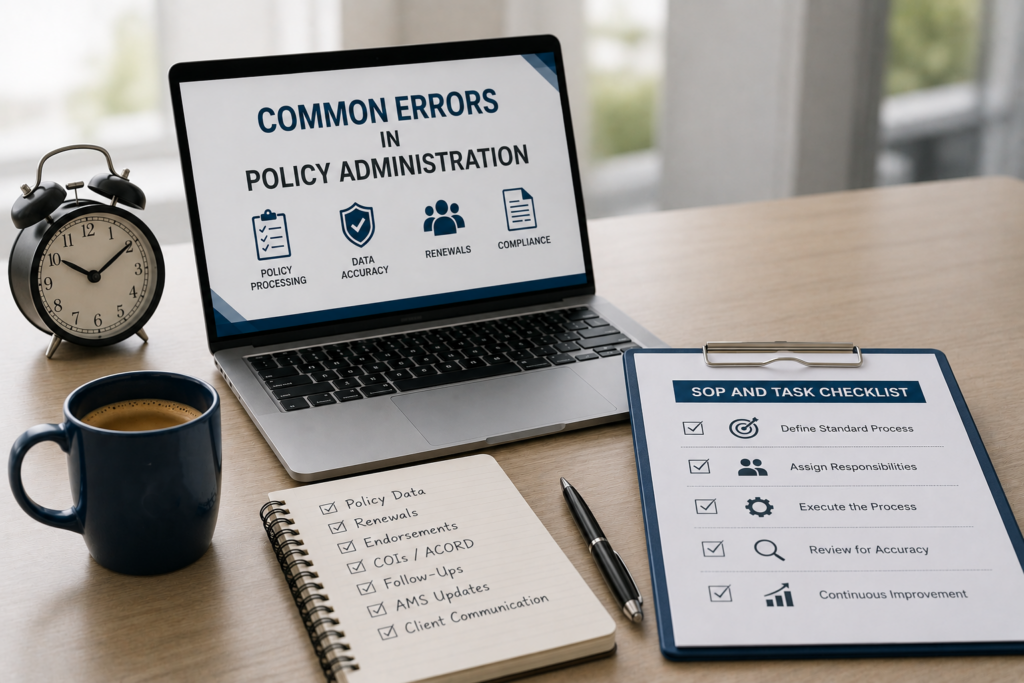
Policy administration is the backbone of every insurance agency. It supports quoting, underwriting, renewals, billing, and client service. When processes run efficiently, operations remain smooth. When they don’t, agencies face delayed renewals, billing disputes, compliance risks, and dissatisfied clients.
Most policy administration errors result from manual processes, growing workloads, and inconsistent workflows, not a lack of effort. Fortunately, these issues can be prevented with standardized procedures and the right operational support.
1. Inaccurate Policy Data Entry
One of the most frequent issues in policy administration is incorrect data entry during new business or endorsements. A small mistake, wrong address, incorrect classification, or missing coverage detail can cascade into larger problems later in the policy lifecycle.
How to prevent it
- Use standardized intake forms.
- Verify data before issuing policies.
- Establish consistent data-entry guidelines.
- Assign dedicated quality checks.
2. Delayed Policy Issuance and Processing
Backlogs, manual document handling, and limited staff often delay policy issuance, affecting customer satisfaction.
How to prevent it:
- Set internal turnaround targets.
- Track pending carrier actions.
- Separate quoting from policy processing.
- Delegate routine administrative work.
3. Missed or Late Renewals
Poor renewal management can lead to coverage gaps, lost revenue, and lower client retention.
How to prevent it:
- Maintain a centralized renewal calendar.
- Begin renewal outreach 30–60 days in advance.
- Assign ownership for every renewal.
- Follow a standardized renewal checklist.
4. Errors in Certificates of Insurance (COIs) and ACORD Forms
Certificates of Insurance (COIs), Evidence of Insurance (EOIs), and ACORD forms require precision. Small mistakes can delay client operations or create compliance issues.
How to prevent it:
- Use approved templates.
- Verify policy details before issuance.
- Standardize document requests.
- Review forms before sending.
Reducing manual intervention in COI processing improves both speed and accuracy.
5. Poor Communication with Clients and Carriers
Communication gaps are one of the hidden causes of policy administration failures. Delayed responses or missed follow-ups can stall entire workflows.
How to prevent it:
- Use shared inboxes or task management tools.
- Assign ownership for follow-ups.
- Track communication within the Agency Management System (AMS).
- Set response-time expectations.
Consistent communication practices directly improve operational efficiency and client satisfaction.
6.Incomplete AMS Updates
An Agency Management System is only as effective as the information it contains. Outdated records reduce efficiency and increase errors.
How to prevent it:
- Use automated reminders.
- Define follow-up schedules.
- Prioritize outstanding tasks.
- Delegate routine follow-ups to support staff.
7. Weak Renewal and Endorsement Follow-ups
Renewals, endorsements, and carrier requests often stall because follow-ups are inconsistent.
How to prevent it:
- Use automated reminders.
- Define follow-up schedules.
- Prioritize outstanding tasks.
- Delegate routine follow-ups to support staff.
Strong follow-up discipline is often what separates efficient agencies from struggling ones.
8. Lack of Standard Operating Procedures (SOPs)
Without documented workflows, employees often complete the same tasks differently, increasing the risk of errors.
How to prevent it:
- Create written SOPs for core processes.
- Train employees consistently.
- Review procedures regularly.
- Standardize workflows across departments.
Standardization reduces dependency on individual experience and improves scalability.
How Agencies Are Addressing These Challenges
Many insurance agencies in the United States and Canada are strengthening operations by outsourcing routine back-office tasks. Rather than expanding internal teams, they partner with specialists like Technoheight to handle policy processing, renewals, endorsements, COIs, carrier communication, AMS updates, and document management.
This approach improves accuracy, reduces turnaround times, and allows licensed staff to focus on client relationships and business growth.
Final Thoughts
Policy administration errors usually stem from small process gaps that accumulate over time. By improving data accuracy, standardizing workflows, strengthening follow-up procedures, and leveraging dedicated administrative support, agencies can reduce errors and improve operational efficiency.
In today’s competitive insurance market, efficient policy administration isn’t just an operational necessity it’s a competitive advantage.